
Migrating to America
During a time of widespread religious conflict in Europe, George Calvert, the first Lord Baltimore, envisioned a colony where all religious sects could live together peacefully and prosper. With the support of the English crown, Maryland was established as a place of opportunity for those seeking a destination for freedom and new beginnings.
These migrations transformed the land that would become the American colonies, encouraging new patterns of settlements, trade, and agriculture while also creating the complicated legacies of Native communities and enslaved people. Our ancestors whether they arrived in the seventeenth century or throughout the next centuries became part of the generations whose decisions to sail into the “unknown” for freedom and prosperity still shape this nation.
Extraordinary Ancestors
Geneological Fan Charts
Leonard Calvert, 1606-1647
First Proprietary Governor of Maryland
The Honorable Thomas Francis Greene, 1610-1652
Passenger on the Ark, 2nd Proprietary Governor of Maryland
Ann Gerrard Cox, abt. 1610-abt. 1638
Gentlewoman passenger on the Ark
Charles Maynard, 1625-1665
Indentured servant, Tobacco planter
Ensign Robert Cole, the Immigrant, c. 1628-c. 1663
Tobacco planter, excellent documentation of seventieth century Colonial Maryland
Major John Wheeler, 1631-1694
Planter, land speculator, juror, Charles County militia, slaveowner
Francis Hayden, 1628-1694
Progenitor of the Maryland Haydens
Samuel Luckett Sr., abt 1650-1705
Juror, Anglican, Charles Co. militia, slaveowner
Arnold Livers, 1669-1751
Raised in the exiled king's household, indentured servant, tailor, treasonous activist, landowner, slaveowner
William Hardy, before 1668-1718
Protestant, soldier, landowner


Top to bottom:
1970 rendering of what the Ark might have looked like by artist, R. Hammond Gibson.
Portrait of Leonard Calvert.
Calvert family seal. The strong yellow and black stripes are now used as a source of design components for the Maryland state flag.
Leonard Calvert, c. 1606 –1647
First proprietary governor of Maryland
Vincent Wheeler's 7th great grandfather
Leonard Calvert was the first proprietary governor of Maryland, serving from 1634 until his death in 1647. He was the second son of George Calvert, 1st Baron Baltimore, who envisioned the colony as a safe haven where English Catholics and Protestants could live together peacefully and prosper. After George died in 1632, his eldest son, Cecil Calvert, inherited Maryland's charter and appointed Leonard to govern the new colony in his absence.
On November 22, 1633, Leonard Calvert and approximately 140 settlers sailed from England aboard The Ark and The Dove. Their voyage across the Atlantic was long and perilous. Just three days after departure, a violent storm damaged The Ark and separated it from the smaller Dove, which was feared lost. Nearly two months later, the two ships were miraculously reunited in Barbados.
Life at sea was harsh. Passengers lived in crowded quarters with little privacy, surviving on salted and preserved foods that often caused malnutrition and scurvy. Seasickness, freezing weather, and the constant danger of storms made the crossing miserable. According to contemporary accounts, twelve passengers died after drinking from a barrel of spoiled wine. Many more became seriously ill. The settlers finally reached Maryland on March 25, 1634.
As instructed by his brother, governor Calvert initially ruled with broad authority granted by the Maryland charter. By 1638, however, the colony's General Assembly had asserted its right to govern according to English common law, limiting that proprietary power.
Religious and political tensions soon
threatened the colony's survival. In 1642,
Calvert seized a trading post belonging
to Virginia colonist William Claiborne,
intensifying a long-running dispute. In
1643 he returned to England, returning
in 1644 with a new wife, Ann Brent,
1612-1651, and family. Two years later,
Claiborne joined Protestant forces in a rebellion against Maryland's Catholic proprietary government, forcing Calvert to flee. He returned with an armed force in 1647 and restored proprietary rule, but the colony had already been deeply divided by years of conflict. Leonard Calvert died later that same year, leaving behind a colony that had survived extraordinary hardship but continued to struggle with the differences between them.
He died suddenly in 1647. Before he died, he named his friend and fellow passenger aboard The Ark and The Dove, Thomas Greene, as his successor to the governorship. Soon after his death in 1649, the Maryland Toleration Act, one of the first laws requiring religious tolerance, was written and enacted in the colony, further codifying its original proprietarial mandate of religious tolerance and re-establishing peace. Children include: William, 1643-; Anne, 1644-.
...envisioned as a safe haven where persecuted English Catholics and Protestants could live together peacefully and prosper.


Top to bottom:
The First Landing of Leonard Calvert in Maryland by David Acheson Woodward, circa 1865-1870.
Portrait of Thomas Greene.
By comparing centuries of DNA, scientists recognize a direct link to our Hayden family from Thomas Green and Ann Cox whose bodies were recently unearthed in St. Mary's City, MD. https://www.popsci.com/science/maryland-colonist-dna/
The Honorable Thomas Francis Greene, 1610-1652
2nd Proprietary Governor of Maryland
Ferdinand Hayden's 6th great grandfather
Thomas Greene was one of the most influential leaders in Maryland's early history. Born in Bobbing, Kent, England, he sailed to Maryland aboard the Ark in 1634 as one of the colony's "twenty gentlemen of very good fashion." A substantial investor in the colony, Greene was a moderate Catholic, a loyal supporter of the Stuart monarchy, and a close friend of Governor Leonard Calvert.
Soon after arriving, Greene married Ann Gerard Cox, whose marriage to Greene is traditionally recognized as the first Christian marriage performed in Maryland. Following her death, he married Winifred Seybourne (Seaborne), who arrived in the colony in 1638.
Greene became one of Maryland's leading landowners and public officials. He served on the Proprietary's Privy Council, was among the first justices of the Provincial Court, and played an important role in shaping the colony's government.
In 1647, Leonard Calvert appointed Greene governor shortly before his death. Greene served until 1649, when Lord Baltimore replaced him with the Protestant William Stone in an effort to ease growing religious tensions. Greene continued to serve as Deputy Governor under Stone.
While Stone was in Virginia in 1649, Greene proclaimed Maryland's loyalty to King Charles I and the Stuart monarchy. The declaration angered the English Parliament, which soon placed the colony under Protestant control. In 1654, the new government repealed the Maryland Toleration Act, ending legal religious freedom and prohibiting the public practice of Catholicism.
Thomas Greene's career reflects the political and religious struggles that shaped Maryland's earliest years. As investor, judge, councilor, and governor, he helped establish the foundations of the colony during one of the most turbulent periods in its history.
By the time of his death, Greene was criticized by the radical elements which were then gaining strength in the Province—particularly from the Puritans who had been driven out of Virginia but had found refuge in Maryland under Lord Baltimore. Baltimore was trying to navigate the growing anger of Parliament in London. Green died in St. Mary’s County, Maryland. Children include: By Anne Cox--Thomas Greene, 1635-1665; Leonard Greene, 1637-1688. By Winifred Seybourne--Robert, 1646-1716; Francis, 1648-1707


Top to bottom:
The mouth of the St. George River today. Thomas Greene and Anne Cox were married in 1634 on the banks of the St. George River.
1984 US postcard's stamp depicting the sailing of Ark and the Dove.
By comparing centuries of DNA, scientists recognize a direct link to our Hayden family from Thomas Greene and Ann Cox whose skeletons were recently unearthed in St. Mary's City, MD https://www.popsci.com/science/maryland-colonist-dna/
Mistress Anne Gerard (widow Cox),
abt. 1610-abt. 1638
Gentlewoman passenger on the Ark
Ferdinand Hayden's 6th great grandmother
Few women are identified among the passengers aboard the Ark and Dove in 1634. While families and servants likely made the voyage, most went unrecorded. They faced boredom, lived in cramped quarters below deck, and slept on thin, straw-filled mattresses with scant privacy. One could bathe only with saltwater, and certainly personal discomfort and dirty linen weigh less in the balance than the danger of being washed overboard when relieving oneself or dumping chamber pots. Meals of salted meat, hard biscuits, and dried peas made one wish for fresh water. Disease was common, and after a
Christmas celebration that included Canary
wine, many passengers became ill and
twelve died.
Anne Gerrard Cox is the only woman of gentle birth known to have sailed on the Ark. As a widow of independent means, she was addressed as "Mistress," a title of respect. In 1633, before the expedition departed England, Lord Baltimore granted her 500 acres of land, making her one of Maryland's earliest female landowners.
Soon after arriving, Anne married Thomas Greene on the banks of the St. George River. Their wedding is traditionally recognized as the first Christian marriage performed in Maryland.
Father Andrew White, the Jesuit priest who accompanied the expedition, praised Anne as "given to much prayer" and devoted to caring for the sick and the spiritual welfare of her neighbors. His account portrays her as a woman of deep faith, charity, and courage whose example helped shape the fledgling Maryland colony.
Anne died within a few years of having arrived in Maryland. Thomas Green and Anne Cox children: Thomas, 1635-1665; Leonard, 1637-1688
there was always the danger of being washed overboard.


Top to bottom:
An indentured servant's work could be grueling. Here two men work in what appears to be processing iron ore.
Example of an indentured servant contract.
Map showing location of "Maynard's Comfort." Note: Francis Hayden's land, "Small Hopes" is nearby but did not exist until the 1670s.
Charles Maynard, 1625-1665
Twelve year old indentured servant, tobacco planter
Ferdinand Hayden's 6th great grandfather
Charles Maynard came to Maryland in 1637 as an indentured servant to Cuthbert Fenwick. Fenwick was one of the original passengers on The Ark and the Dove. Maynard was twelve years old at the time of his arrival. When he completed his service in 1649, he was patented 100 acres of land on St. Clement’s Bay.
For many years the majority of the white population emigrating to the providence of Maryland were termed “servants,” a term somewhat similar to our use of the word “employee.” Such a person would agree to work for a certain number of years in exchange for transportation to the colony. The average indentured servant was a respectable young person desiring a better life in the New World but lacking the means for the costly sea voyage. The Lord Proprietor needed to populate his province and so devised the “servant system” to supply the means for the voyage. When a servant completed his or her time of service they would be entitled to fifty acres of land.
Maynard's 1649 patent states that Charles Maynard, Planter, performed his services to Cuthbert Fenwick and was entitled to 50 acres. Fenwick gave Maynard an additional 50 acres he had earned for bringing him into the country. Maynard later received 400 additional acres in two separate patents by the Lord Proprietor from lands of deceased individuals citing “in consideration of faithful service” with the expectation of “like acceptable service for the future.” Maynard settled on St. Clements Bay in the New Town Hundred calling his home Maynard’s Comfort.
Maynard's Comfort was located on Clement's Bay where highways #242 and #234 intersect at today's round-about, became the property of John Rapiere (d1687/8) through his marriage to Charles and Ann Maynard's daughter, Elizabeth. The land was passed down through several generations of Rapiers to Captain Richard James Rapier (1744-1817) who we will discuss in the Colonial Period. Children’s include: Agnes, Elizabeth, Charles (aft. 1661-)


Top to bottom:
Detail of early American ledger.
Replica of panel posted in original St. Francis Xavier church, the oldest Catholic Church in continuous operation within the original thirteen colonies. The title of the poster reads "Ad preptuam rei memoriam," a Latin phrase meaning "for a perpetual memory of the thing." It signifies a document created to preserve an significant event for lasting remembrance. It is signed by Robert Cole and two of the men who managed his affairs once Cole left for England.
Existing structure demonstrating location and size of chapel built with Cole's help. It is surrounded by community's graveyard.
Book published by the University of North Carolina Press providing a unique view of Robert Cole's farm and 17th century Chesapeake life and history.
Ensign Robert Cole Sr., (The
Immigrant), c. 1628-c. 1663
Tobacco planter, Maryland militia, exceptional accounts of Chesapeake
colonial economy
Ferdinand Hayden's 6th great grandfather
Robert Cole Sr. (c. 1628–c. 1662) arrived in Maryland in 1652 with his wife, Rebecca, four children, and two servants. He appears to have been a prosperous man in England, the son of a landowner and probably a Roman Catholic. The fluent, carefully composed language of his will and inventory suggests that he had received a formal education, an advantage enjoyed by relatively few seventeenth-century colonists. He likely financed the family's passage by selling land in England, while Maryland's policy of religious toleration made the colony an attractive destination for English Catholics seeking greater security.
Upon his arrival, Cole purchased land outright and began the demanding work of establishing a plantation. Forest had to be cleared before fields could be planted, and he soon built a dwelling house, a tobacco-curing house, and the other structures necessary for a working farm. Tobacco was the plantation's principal cash crop, but the family also cultivated vegetable gardens and maintained poultry under Rebecca's supervision. Cole planted an orchard as well, since cider was the colonists' principal everyday beverage. Cattle and swine ranged freely through the surrounding woods, as was customary in early Maryland.
Within ten years, Cole had become a successful tobacco planter. By the time he prepared to leave Maryland, his estate—consisting of land, livestock, servants, household goods, and outstanding debts owed to him—was worth approximately four times his original investment. He also helped organize and build a small Catholic chapel and burial ground on Newtown Neck, contributing to the religious life of one of Maryland's earliest Catholic settlements. In public affairs, he served as a juror in the provincial court and attained the rank of ensign in the militia, whose duties included defending the colony and maintaining order during periods of frontier danger and political unrest.
The reasons for Cole's decision to return to England after a decade in Maryland remain unknown. Before departing, however, he made careful provision for both his family and his estate. He prepared a detailed inventory of his possessions and executed a comprehensive will. Rebecca apparently died during this period, for she is mentioned in the inventory but not in the will. At the time of his departure, Cole left behind five surviving children of his own and two stepchildren; two of his children had died earlier. His stepdaughter, Anne Knott, had already established a household of her own, likely in anticipation of marriage. In a society where women often married during their mid-teenage years, such an arrangement was not unusual.
Cole entrusted the care of his children and the management of his plantation to two trusted neighbors, Luke Gardiner and William Evans, together with his cousin, Henry Hanckes. He then sailed for England. By September 1663 he was dead, although neither the date nor the circumstances of his death have been discovered.
Cole's foresight produced one of the most remarkable documentary records surviving from seventeenth-century Maryland. Acting as trustee, Luke Gardiner maintained meticulous accounts of the plantation's income and expenditures for nearly twelve years. His records identify members of the household, document the hiring and service of indentured servants, record crops produced and goods sold, and detail the supplies necessary to maintain the plantation. The accounts conclude with an inventory of the property distributed to Cole's children as each reached legal age.
The survival of these records gives Robert Cole Sr. an importance that extends well beyond his own family. Gardiner's accounts provide more detailed evidence of the domestic economy of a seventeenth-century Chesapeake plantation than any other comparable body of documents known from the period. When combined with land records, probate files, court proceedings, and other contemporary sources, they allow historians to reconstruct the daily rhythms of plantation life with unusual clarity. Through these extraordinary records, Robert Cole, his family, and their plantation occupy a central place in the history of early colonial Maryland and the Chesapeake region.
Children Included: Anne Knott, 1625-1651; Francis Knott, 1649-1705; Robert Jr., 1652-1695; Mary, 1654-; William, 1655-1683; Edward, 1657-1718; Elizabeth, 1659-1670


Top to bottom:
Clearing land would have been Wheeler's first priority after claiming land.
As a successful Maryland planter tobacco would have been his main crop initially requiring indentured servants, but Wheeler would likely have switched to slave labor with as much land speculation as he was involved in.
Example of flintlock mechanism from St. Mary's City archives. It would have been used for 17th century Maryland militia.
Major John Wheeler, 1630-1693
Planter, land speculator, juror, Charles County militia, slave owner
Vincent Wheeler's 6th great grandfather
The Puritan Rebellion in England reached its climax in 1649 when Charles I was beheaded. The supremacy of the Puritans placed Catholics in a difficult position. John Wheeler was 21 years old in 1651 when he left England for the British Colonies. A Roman Catholic, his religious convictions were a handicap to him in Maryland since Oliver Cromwell sent forces “to reduce all the plantations within the Chesapeake Bay to their due obedience to the Parliament of England.” A period of unrest followed until 1658 when Lord Baltimore was allowed to exercise his authority again.
Although records suggest he may have arrived as an indentured servant, Wheeler's exact status is uncertain. Land patent records imply he received land for transportation rights, yet he appears to have avoided completing a full seven-year indenture. His disappearance from Maryland records between 1652 and 1654 has led to speculation that he may have lived temporarily in Virginia under the name "John Henry Wheeler."
By 1654 Wheeler had married Mary Causine, 1631-1694. Over the following decades, he established himself as a prosperous planter, military officer, and public official.
-
In 1661 we find the first notice of his military service as he is identified as an Ensign (1st Lieutenant) with documentation of payment for services of 440 pounds of tobacco.
-
In 1666 he participated in operations against Native Americans; in 1676 promoted to the rank of Captain.
-
Between 1679 to 1684 he held the position of Major of the Infantry for Charles County.
-
In 1692 was removed from all tax rolls due to his age and wounds received in the country’s service.
A successful farmer and land owner, Wheeler traded extensively in Charles and Prince George’s county including business transactions with Robert Cole Sr. It is probable his servants were a combination of indentured and slaves. Large land holdings often required slave labor. At the time of his death he owned over 4,000 acres.
Children include: John, 1654-aft.1688; James, 1656-1685; Mary, 1658-1708; Thomas, 166k0-1735; Winifred, 1663-1725; Ignatius, 1670-1736.


Above, Top to bottom:
Detail of Francis Hayden's will.
Jennifer (Hayden) Patterson, her parents, Sharon and Dennis Hayden, and Paige Patterson standing in "Heydon Chapel" in St. Mary's parish church in Watford, Hertfordshire, England. Francis Hayden was baptized in the original church in Watford, but much was lost during the bombings of WWII. "Heydon chapel" is original to the building.
Map showing Hayden's Small Hopes in southern Maryland. Note: Maynard's Comfort is nearby showing ownership of both Maynard and Rapier land. It appears the families grew up together from these earliest generations until their arrival in Kentucky.
Right:
Hayden English Ancestry as provided by Arizona's United States Senator Carl Hayden, 1877-1972. Francis Hayden (with the double asterisks) is the Maryland Hayden.
Francis Hayden, 1628-1694
Progenitor of the Haydens from southern Maryland
Ferdinand Hayden's 5th great grandfather
Francis Hayden (whose surname also appears as Haydon, Heyden, and Heydon) was born on August 14, 1628, in St. Mary's Parish, Watford, Hertfordshire, England. The multiple spellings of his surname are typical of the seventeenth century, when standardized spelling was uncommon and clerks often recorded names phonetically.
Hayden was a native of England. His birth is registered in the parish church of St. Mary’s of Watford, Hertfordshire, England on August 14, 1628.
By 1665–1666, Hayden was living in Westmoreland County, Virginia, where records describe him as a planter. He sold 500 acres of a 1,000-acre tract that he co-owned and, in 1666, received another 1,000 acres for transporting 20 peopleinto Virginia. These transactions suggest that he was already a man of substantial means and actively involved in land speculation and the headright system.
Hayden married Thomasin Butler (1630-
1702) while still in Virginia. Arriving in
Maryland sometime prior to 1675,
Hayden, accompanied by his wife, and two
daughters, leased land called “Small Hopes.”
While living in Virginia, Hayden married Thomasin Butler (c. 1630–1702). Before 1675, the family relocated to St. Mary's County, Maryland, where they leased a tract known as "Small Hopes." After meeting Maryland's residency requirement, Hayden claimed 200 acres under the colony's headright system for transporting himself, his wife Thomasin, and their two daughters into Maryland. His son William Hayden was born in St. Mary's County in 1675.
Other than land transactions, we have few details of Hayden's life in Maryland. He died in 1697 leaving all his property to his wife, Thomasin. Five years later, Thomasin died. She left “Small Hopes” to her son, William, originally called “Newington” near St. Clements Bay.
Children included: Mary, b 1665- aft 1717; Penelope, before 1670-after 1696; William H., 1674-1734
Francis hayden was the progenitor of the hayden family of st. mary's county, MD.


Top to bottom:
Under sail. The only way travel between England and her colonies was via sail.
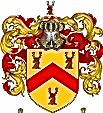
Luckett coat of arms.
Samuel Luckett Sr., abt 1650-1705
Juror, Anglican, Charles Co., militia, slaveowner
Borgia (Higdon) Hayden's 6th grandfather
Born in Kent England in 1650, Samuel Luckett was the progenitor of the Luckett family in the Colonial America. By 1696, he had attained prominence in Maryland as a member of the Provincial Court, a position that suggests his alignment with the Church of England following the political changes after the Coode Rebellion of 1689.
Samuel’s arrival in Maryland remains uncertain, though his failure to claim the customary fifty acres granted to permanent settlers suggests he may have arrived independently rather than as an indentured servant. In 1678, he participated in the Nanticoke Indian War, indicating that he was a young and active member of the colony’s frontier community.
On November 24, 1683, Samuel married Elizabeth Hussey, widow of John Gardiner and a member of one of Maryland’s early Catholic families connected to the Ark and Dove settlers. Together they had four sons: Samuel, Thomas, Ignatius, and Thomas Hussey Luckett. Their children’s names reflect the importance of family tradition, with Thomas Hussey honoring Elizabeth’s family and the repeated use of Thomas possibly preserving a connection to Samuel’s English ancestry.
Through his settlement in Maryland, military service, marriage, and public career, Samuel Luckett established the foundation of a family that would continue through generations. His story marks the beginning of the Luckett legacy in America, linking English origins with the developing history of Colonial Maryland. Children of Samuel and Elizabeth (Hussey): Samuel 1685-1725; Thomas 1688-1734; Ignatius 1689-1735; and Thomas Hussey 1697-1767.


Top to bottom:
A contemporary view of land that at one time was owned by Arnold Livers, called Arnold's Delight in present day Frederick County, Maryland. At the time of Livers death, Arnolds Delight consisted of 1,649 acres. It sits just above Camp David. The photo is taken from the National Shrine Grotto of our Lady of Lourdes at Mount St. Mary's University.
Map of Arnold Livers amassed lands at the time of his death in 1751.
Theresa Hayden and Janice Wheeler standing under a covered bridge which now stands in the middle of what was Arnold's Delight. The bridge did not exist in Livers day.
Gravestone of Jocoba Clementina, Arnold Livers eldest daughter. She inherited a portion of Arnold's Delight. Jacoba was the 2nd wife of William Elder Sr. The immaculately cared for Elder family cemetery exists today just north of land that was Arnold's Delight.
Arnold Livers, 1669-1751
Raised in the exiled King's household; indentured servant, tailor, treasonous activist, landowner, slaveowner
Ferdinand Hayden's 4th great grandfather
Borgia (Higdon) Hayden's 4th great grandfather
Arnold Livers' life was marked by loyalty, perseverance, and reinvention. Born in Flanders, Belgium, of English parentage, he grew up within the royal household and rose to become Page of the Backstairs, a trusted position that gave him personal access to the exiled King James II of England. He also held minor military responsibilities and remained devoted to the Stuart cause during the political upheaval that ended James II’s reign.
When the Glorious Revolution of 1688 forced James II into exile, Livers fought in defense of the king until the final days of the struggle. He eventually fled England for his life, still wearing his uniform. Family tradition preserves buttons and buckles from that uniform as reminders of his service.
Between 1688 and the 1690s, Livers arrived in Maryland, transported by Colonel Henry Darnall, a prominent Catholic official in the colony. Maryland records describe him as a yeoman, indentured servant, merchant, and gentleman, with tailoring listed as his trade. His three-year indenture was unusually short, and his skills likely allowed him to quickly establish himself as an independent craftsman and landowner.
Yet questions remain about Livers’ unusual circumstances. A man who had served within the royal household and had ties to the defeated Stuart monarchy would have had reason to conceal
his identity. If enemies of James II were searching
for former royal supporters, assuming the role of
an ordinary tradesman may have provided a
safer path to a new life.
After learning that his first wife had died, Livers
married Helen Gordon in 1704. She later traveled
to Europe to bring his two sons from his previous marriage to Maryland. After Helen’s death, he married Mary Ann Drane in 1721.
Over time, Livers acquired significant land holdings in Prince George’s and Frederick Counties, providing his descendants with a lasting inheritance. His journey from royal service in Europe to property ownership in colonial Maryland reflects a remarkable story of courage, adaptability, and determination.
Arnold Livers’ legacy is not only found in the land he acquired but also in the generations of family who followed. His life stands as a testament to the ability to overcome upheaval, build anew, and create a lasting place in history.
Children included: 1st wife in Flanders--John Livers, 1686 (England); 2nd wife, Helen Gordon, 1684-1718--Father Arnold Livers IJ, 1705-1767; Jacoba, 1717-1807, James, 1718-; 3rd wife, Mary Ann Drane, 1702-1742--Anthony, 1734-1820, Arnold, 1736-1777, James Robert, 1738-1785, Mary Ann, 1739-1825.
How best to hide from the most powerful army on earth at that time than as an indentured servant?


Top to bottom:
1A new map of Virginia, Maryland, Pennsylvania, and New Jersey, 1721
Reconstruction of Maryland's original State House in St. Mary's City.
William Hardy, before 1668-1718
Protestant, landowner, soldier
Borgia (Higdon) Hayden's 5th great grandfather
Little is known about Hardy’s early life or his arrival in Maryland, except that he was an immigrant from Dorset, England. His story stands out because he arrived during one of the colony’s most significant periods of political and religious change.
A Protestant, Hardy became involved in the events surrounding Coode’s Rebellion of 1689, a Protestant-led uprising that ended Catholic political control in Maryland. As a soldier in the rebellion, Hardy signed a loyalty oath to the King of England, aligning himself with the forces seeking to replace the Catholic proprietary government of Charles Calvert, Lord Baltimore.
The rebellion grew from years of tension over fears of Catholic influence, economic difficulties, and rumors of alliances between Catholic leaders and Native Americans. In April 1689, approximately 700 armed Protestants formed an “Association in Arms,” marched on St. Mary’s City, and forced the surrender of the proprietary government with little bloodshed.
The aftermath dramatically changed Maryland.
Catholic political power was removed, Catho-
licism was restricted, and Roman Catholics
lost the right to vote. Maryland became a royal
colony under direct English control until 1716,
when governance returned to the Calvert
family after the fourth Lord Baltimore converted
to Anglicanism.
Hardy’s participation places him among the many settlers whose lives were shaped by Maryland’s struggle over religion, loyalty, and political identity. Though few details of his personal life survive, his role during this pivotal moment connects his family history to a major turning point in the colony’s development.
Hardy and his wife, Elizabeth, 1672-1728
shared seven children: William, 1697-1740; George, 1698-1758; Mary, 1699-1751; John, 1701-1742; Martha, 1703-; Ignatius, 1714-1764; Elizabeth, 1714-
within two generations Arnold Livers' and William Hardy's grandchildren (two men with extremely opposite religious and political views) MARRIED.