
Colonial Period
Colonial Maryland experienced dramatic political, religious, and cultural change during the seventeenth and eighteenth centuries. Catholics, Puritans, Quakers, Baptists, Presbyterians, and other religious groups rose and fell in influence, while Native American communities experienced profound disruption as European settlement expanded.
Many of our ancestors settled directly in Maryland, while others established homes along the eastern seaboard, contributing to trade, transportation, agriculture, and economic growth throughout the colonies. Through periods of conflict, migration, and ultimately the American Revolution, the Hayden family and our allied ancestral families participated in the events and communities that helped shape our lives today.
Background Photo: The first colonists to arrive in Maryland purchased bark-covered wigwams from local Piscataway tribes who deemed the structures no longer useful.

Courageous Ancestors
Geneological Fan Charts
The Honorable Edward Guy Cole, 1657-1717
Robert Cole III, 1686-1720
Robert Cole IV, 1720-1771
Maryland provencial court juror, tobacco planters, merchants, slaveowners
Colonel William Luckett, 1711-1783
Orphan, ferryman, land owner, Maryland militia
Jacob Van Metre, 1723-1798
Ever-restless, Virginia militia, French and Indian War militia, Kentucky leader, slaveowner
John Hart, 1713-1779
Signer of the Declaration of Independence
Captain John Quicksall, 1742-1786
Quaker, Captain, New Jersey 1st Regiment of Burlington County Volunteers, patriot
Basil Hayden, 1744-1804
Merchant, Maryland militia, military supplier, patriot, distiller, visionary leader of the 1st "Catholic League of Families", slave owner
Henrietta (Cole) Hayden, 1754-1836
Wife, mother, homemaker, patriot, pioneer, widow
Captain Richard James Rapier, 1744-1817
Tobacco planter, Captain Maryland militia, patriot, leader of 2nd group of "Catholic League of Familiesf" to Kentucky, slave owner
WHY AN "OATH OF ALLEGIANCE?"
Electius Thompson, 1750/55-1840
Francis Hayden's great grandson, orphan, patriot, Baptist minister
Charles Thompson, 1760-
St. Mary's County 5th Independent Company, prisoner of war, farmer, slave owner
Jacob Van Metre, 1752-1838
Ensign/Captain, George Rogers Clark Illinois battalion, patriot
Robert Wilson, 1754-1835
Captain, 6th Pennsylvania Battalion in the Continental Army, assistant to the Deputy Quartermaster of the Western Army, patriot
Major William Chenoweth, 1760-1828
George Rogers Clark frontier campaign, "cornstalk militia"


Top to bottom:
Edward Cole spent seveformative years in England furthering his education.
18th century typical Mid-Atlantic wharf
Cole recognized the advantages of slave labor vs. using indentured servants.
The Cole family planted orchards early recognizing the popularity of cider.
The Honorable Edward Guy Cole,
1657-1717
Maryland provincial court juror, tobacco planter, merchant, slave owner
Ferdinand Hayden's 5th, 4th and 3rd great grandfathers
Mary Ursula (Smith) Hayden's 4th, 3rd and 2nd great grandfathers
The third son of Robert and Rebecca Cole, Edward Cole was the only one of their children to build wealth. Having been born in and lived his entire life at St. Clements Manor, St. Clements 100, St. Mary’s county, Provencial Maryland he came to represent a well established colonial family with his descendants each, also, increasing wealth through land and slaves. He married twice, first to Honora (Ford) Cole and then the widow Elizabeth (Slye) Gardiner.
His early childhood included 5 years of schooling. In 1672 he sailed for England; it is assumed to continue his education. On his return he held offices as a juror in the county land and provincial courts. In the 1600s “juror” did not mean what it does today. The duties included investigating offenses to determine whether there was evidence to bring formal charges, report on public concerns, and act as a voice for the community to propose new laws or protest government abuse.
Originally inheriting 200 acres, at his death he owned 575 acres with personal property worth more than three times that of his father. He had diversified his occupations to include both farming and wholesaling—serving as the merchant representative of a London firm and able to identify himself as “Mr.” He had made the leap from using indentured white labor, which was cheaper but also only good for a contracted number of years, to slave labor, which lasted for not only the life of the slave, but also of any children a slave woman might have. Children included: Elizabeth; Robert, 1686-1720; Honour; Susanna, 1692-1763; Mary; Edward, 1696-1762
Robert Cole III, 1686-1720
Maryland tobacco planter, slave owner
Robert Cole III's father, the Honorable Edward Guy Cole, lived to the age of sixty, passing away in 1717—allowing Robert to live his entire life in St. Clements Manor, St. Clements 100. As a grown man in his late twenties, Robert Cole III inherited the home dwelling and a significant portion of land. Shortly before his father’s death in 1716 he married Elizabeth (Herbert) Cole (1695-1775) whose mother was Grace (Hayden) Herbert (1695-1760), granddaughter of Francis Hayden. They had two children and Elizabeth was pregnant with a third when Robert Cole III passed away in 1720 at about thirty-three years of age. It was not unusual for individuals to pass away at such a young age. The cause of death is unknown, though likely his health declined because he prepared a will in 1719. Children included: John, d. 1752; Robert IV, d. 1771; Mary, 1720-1760
Robert Cole IV, 1717-1771
Henrietta Cole's father, tobacco planter, slaveowner
Robert Cole IV was born into one of Maryland’s early Catholic families, but he never knew his biological father. His father, Robert Cole III, died on March 30, 1720, leaving his young wife, Elizabeth Herbert Cole (1695–1775), a widow. On June 8, 1720, Elizabeth married James P. Thompson (1685–1732), a widower from a family already closely connected with the Coles. James Thompson became the only father Robert IV would know. The quick remarriage reflected the realities of colonial life, when family alliances and the care of children were essential. The Cole and Thompson families were already intertwined through earlier marriages, creating strong bonds within the close Catholic community of St. Mary’s County.
Robert Cole IV remained on the family lands in St. Clement’s Hundred and later married Ann Greenwell (1720–1751) before 1744. The Greenwell family lived nearby on the Newtown Hundred, separated from the Coles only by St. Clement’s Bay. Their shared Catholic faith brought these families together through worship, marriage, and burial traditions.
The Cole family’s roots reached back to the early Catholic settlement of Maryland. In 1661, Robert Cole, the immigrant, helped establish a chapel and burial ground on Newtown Neck. By 1731, Jesuits were educating local children, and St. Francis Xavier Church was established as a permanent center of worship. It remains today the oldest continuously operating Catholic parish founded in the original thirteen colonies.
Through faith, family, and connection to the land, Robert Cole IV carried forward the legacy of generations of Maryland’s early Catholic settlers. Children include: Jane, 1744-1771; Margaret, 1745-1823; Elizabeth, 1749-1774; Mary, 1752-1794; Henrietta, 1754-1836; Eleanor, 1757-


Top to bottom: Scene depicting battle during the French and Indian War.
Bostonians reading the first Stamp Act announcements.
Warning stamp used by colonists to not purchase items included in the 1765 Stamp Act such as all printed material including legal documents, newspapers, playing cards, dice, etc.
Colonel William Luckett, 1711-1783
Orphan, ferryman, landowner, Maryland militia
Vincent Wheeler second cousin, 5 times removed
William Luckett's early life was shaped by hardship and resilience. When his father died in 1725, William was considered an orphan under colonial law and was placed under the care of a guardian to be apprenticed in a useful trade so he would not become a burden on the county. He was separated from his mother, suggesting that his father’s estate was too small or insolvent to provide for him. In 1728, his guardian was called before the court to explain why William had not yet learned to read or write, but he eventually overcame these difficulties. Many documents bearing his skilled handwriting remain preserved in the Frederick County courthouse.
As an adult, William settled along the frontier of Frederick County near the lower slopes of the Blue Ridge Mountains, where he operated a ferry across the Potomac River at a site now known as Noland’s Ferry on the C&O Canal. Though likely raised Catholic, he joined the Church of England because Catholics were restricted from holding public office in colonial Maryland. In 1740, he married Charity Middleton (1717–), daughter of John and Mary (Wheeler) Middleton of Prince George’s County. Over the years, William expanded his land holdings and became a respected member of the community.
During the French and Indian War, William Luckett served as a militia officer. He later became a Frederick County magistrate and was one of the twelve Maryland justices who unanimously rejected the Stamp Act on November 23, 1765, refusing to enforce the use of taxed stamped papers. From 1767 to 1771, he represented his local hundred in the Maryland General Assembly.
As tensions grew between the colonies and Great Britain, Luckett became increasingly involved in the movement toward independence. By 1775, he held the rank of lieutenant colonel and was among the senior militia officers in his region. In 1777, he served during the Revolutionary War and participated in the Battle of Germantown, continuing a lifetime of public service to Maryland.
Children include: Samuel; William Luckett married Sarah Nelson; Verlinda, 1747-1799; John married Polly Ann; Susannah married David; Thomas Hussey married Elizabeth; Anne; Elizabeth married Thomas Offutt; Mary Eleanor married Thomas Noland; Levin married Letitia Peyton.


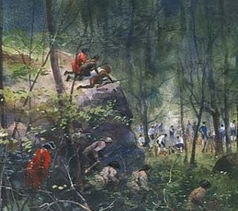
Top to bottom:
The wilderness proved a strong pull for the entire Van Meter family.
As the French and Indian War began, an important role for the militia was cutting roads through the wilderness.
Virginia militia observe French soldiers.
Jacob Van Metre, 1723-1798
Ever-restless, French and Indian War militia, early Kentucky leader, slaveowner
Anna (Faith) Wheeler's 4th great grandfather
Jacob “Jake” Van Metre was born into a family shaped by the frontier. His father, John, and uncle, Isaac, were Indian traders who traveled through the wilderness along the northwestern edge of Virginia—lands that would later become West Virginia, western Maryland, and Pennsylvania. Their journeys gave the family a deep knowledge of the frontier, and they eventually settled in what is now Berkeley County, West Virginia. There, Jake became a prosperous landowner and married Letitia Strode.
When the French and Indian War began in 1755, Jake joined the Virginia militia and was assigned to Fort Cumberland. He was expected to join General William Braddock’s expedition through the Allegheny Mountains toward Fort Duquesne. Because military records were limited, we may never know for certain whether Jake was with Braddock when the army was ambushed, but he was among those who helped defend the frontier during a dangerous time.
After the war, Jake continued pushing westward. In 1768, he joined an expedition into what is now southwestern Pennsylvania, where settlers claimed lands awarded for military service. They marked their claims by “tomahawking” trees and built stockades around their cabins for protection. During the years leading up to the American Revolution, Jake also supported the patriot cause by helping collect supplies such as gunpowder, lead, flint, and cartridge paper.
In 1779, Jake moved his family and other settlers to the Falls of the Ohio, eventually settling in what became Hardin County, Kentucky. There he helped build Van Metre’s Fort, established Severns Valley Baptist Church—the oldest Baptist church in continuous use west of the Alleghenies—built a grain mill, and operated a licensed tavern for travelers.
One of the most memorable parts of Jake’s story is his relationship with Bamboo Harris and his wife, Dinah, two enslaved people whom he had already freed. In his will, Jake directed that his remaining enslaved people be freed after his wife’s death or when they reached the age of 30.
After Jake’s death, Bamboo Harris moved to Ohio, where in 1801 he built the first grist mill in Butler County. Today, a historical marker and three worn millstones preserve the memory of his achievement.
Jacob “Jake” Van Metre’s life reflects the courage and determination of early American settlers. His story is one of exploration, service, community building, and a family legacy that continued across generations. Children include: Eleanor, 1742-1820; Abraham, 1744-1781; Martha, 1745-1803; Rebecca, 1746-1804; Susan, 1750-1798; Elizabeth, 1752-1848; Rachel, unknown; Mary, 1757-1832; Issac, 1759- 1840; Margaret, 1759-1843; Jacob Jr., 1762- ; John, 1764-1850; Alcinda, 1766-1834.


Top to bottom:
Engraving of. John Hart farm.
Portrait of John Hart. .
New Jersey Colonial currency (1776) signed by John Hart.
John Hart, 1713-1779
Signer of the Declaration of Independence
Borgia (Higdon) Hayden's second cousin, 7 times removed
John Hart was a gentleman farmer who acquired extensive properties in New Jersey, where he grew grains for his mill, raised a large number of livestock, and reared his 13 children. A natural leader in his community and church, he earned the trust and respect of his neighbors, who affectionately called him “Honest John Hart.” Although he preferred the quiet life of his farm, he repeatedly answered the call to public service.
As tensions between the colonies and Great Britain grew, Hart became increasingly committed to the cause of freedom. In 1765, he helped select New Jersey’s delegates to the Stamp Act Congress. Later, he was elected as a member of New Jersey’s delegation to the First Continental Congress, where the delegates initially opposed independence. However, by the time of the Second Continental Congress, Hart’s position had changed. On July 4, 1776, he proudly signed the Declaration of Independence.
By December of that year, British forces had advanced into New Jersey, forcing Hart to flee from the bedside of his seriously ill wife. Because the British were seeking out the Declaration’s signers, Hart became a hunted man. He moved constantly through the countryside to avoid capture, rarely sleeping in the same location for two consecutive nights. At one point, he hid in the “resting place of a large dog” to escape detection by a nearby patrol. Several times, he was forced to flee at a moment’s notice to “save his neck,” as he had been “marked for vengeance” by the British. During his absence, his farm was raided by British and Hessian troops, who damaged the property but did not destroy it.
The Continental victory at Trenton on December 26, 1776, allowed Hart to safely return home. Before the Battle of Monmouth, he invited General George Washington and the Continental Army to establish their camp on his farm, and Washington accepted his offer. From June 22 to 24, 1778, approximately 12,000 soldiers occupied Hart’s fields, and Washington is believed to have dined with him during the encampment.
Hart was slowly able to begin restoring his property. However, the hardships he endured during the war—including physical strain, exposure, and constant uncertainty—permanently damaged his health. His farm was eventually sold to help cover his war-related debts. John Hart died before the end of the Revolutionary War, never witnessing the independence for which he had sacrificed so much.
Hart married Deborah Scudder, 1721-1776. Children include: Sarah Hart Wickoff, 1741-1821; Jesse, 1742-1795; Martha Hart Wood, 1746-1794; Nathaniel, 1747-1825; John Jr., 1748- ; Susannah Hart Polhemus, 1750-1832; Mary, 1752- ; Abigail Hart Stout, 1754-1832; Edward, 1755-1812; Scuddard, 1759-1776; Daniel, 1762-1848; Deborah Hart Ott, 1765-1848.


Top to bottom:
We know Quicksall fought in the Battle of Treton, so he would have crossed the Delaware River on the night of December 25th, 1776.
Quicksall and his men supported Washington's escape from Long Island. Had Washington not been successful, the war would have been over in August of 1776.
Quicksall was at Valley Forge in the winter of 1777-1778.
Captain John Quicksall, 1742-1783
Quaker, Captain, New Jersey First Regiment of Burlington County
volunteers, patriot
Borgia (Higdon) Hayden's 5th great grandfather
At the outbreak of the American Revolution, John Quicksall Jr. (1741–1783), a Quaker from Burlington, New Jersey, organized a company of 100 men at his own expense despite the objections of his father. Chosen by his men to serve as their captain, Quicksall received his commission on August 26, 1775. His company was incorporated into the First Regiment of Burlington County Volunteers.
In 1776, Captain Quicksall served with distinction under General George Washington during the campaign in New York. Following the brutal Battle of Long Island, the American cause came perilously close to collapse. Only Washington’s daring nighttime evacuation of his army across the East River prevented the Revolution from ending in defeat. Later that year, on December 26, 1776, Quicksall accompanied Washington on the famous crossing of the Delaware River. He then participated in the remarkable ten-day campaign that included the victories at Trenton, Assunpink Creek, and Princeton, victories that revived American morale and renewed hope for independence.
In 1778, Quicksall fought in the Battle of Monmouth. After spending the harsh winter at Valley Forge rebuilding and training the Continental Army, Washington was determined not to allow the British to withdraw to New York unchallenged. The battle began poorly for the Americans as General Charles Lee's advance force faltered and retreated before the larger British army. A determined rear guard action bought Washington the time needed to rally his troops and establish a strong defensive line. The fierce infantry fighting eventually gave way to an extended artillery duel before the British withdrew under cover of darkness. Although the battle ended without a clear tactical victor and both armies suffered heavily from the intense heat as well as combat, it marked a turning point by demonstrating the growing discipline and effectiveness of the Continental Army while reinforcing Washington's leadership as commander-in-chief.
The hardships of war took a lasting toll on Quicksall's health. Although he survived to see the United States achieve its independence, he enjoyed that freedom for only a short time. John Quicksall Jr. died on October 10, 1783. His wife, Elizabeth Hunt Quicksall (1744–1784), who was pregnant at the time of his death, was left to care for their four young children. She died the following year, apparently from complications of childbirth. Despite having opposed his son's decision to take up arms, Quicksall's father paid off the substantial debts John had incurred while financing his company. Following the deaths of both parents, Elizabeth's father, John Hunt, took the orphaned Quicksall children to Kentucky, where they began new lives on the American frontier. Children include: Aaron, 1776-; Sarah, 1777-1832; John III, 1779-; Elizabeth, 1782-1864; Mary, 1784-


Top to bottom:
1675 John Speed map of Maryland and Virginia. As a successful merchant he would have been aware of politics beyond our borders.
Bust of Basil Hayden.
Map of original Hayden land in southern Maryland. Note its proximity to "Maynard's Comfort," Rapier land. Both born in 1744, Basil Hayden and Richard James Rapier must have known each other well.
A pistol commonly supplied to American soldiers during the Revolution. This pistol was from France.
Proclamation from the First Continental Congress directing merchants to stop all commerce with Great Britain.
Basil Hayden Sr., 1744-1804
Merchant, tobacco planter, Maryland militia, military supplier,
patriot, visionary leader of a "League of Catholic Families"
Joseph Ferdinand Hayden's 3rd great grandfather
Basil Hayden Sr. was born in St. Mary’s City, Maryland, in 1744. The Hayden family had settled along the western shore of the Chesapeake Bay in the 17th century, drawn by Maryland’s promise of religious tolerance. Before the American Revolution, his father, George Hayden, was a prosperous merchant who supplied provisions to the British Colonial Army.
By the mid-1700s, economic and political tensions were mounting. Tobacco had exhausted the region’s soil, leaving many planters deeply in debt. At the same time, Britain sought to recover the cost of the French and Indian War by imposing new taxes, including the Sugar Act of 1764. Resistance spread rapidly in Maryland. In 1765, a British tax collector was nearly killed by an angry crowd in Annapolis, and in 1774 Maryland patriots burned a cargo vessel whose captain had violated the colonial boycott of imported tea.
As imported rum became scarce, many colonists turned to distilling whiskey from locally grown grain. Basil Hayden was among these early distillers, producing a high-rye corn whiskey that would later influence Kentucky bourbon. During the war, he also served as a merchant, helping supply the Continental Army with provisions from Maryland, known as the "breadbasket of the Revolution."
By 1776, Hayden had joined the St. Mary’s County Militia. That July, British forces attempted an invasion of St. Mary’s County in what became known as the Battle of St. George’s Island. The British fleet sought provisions, and accounts report that they also attempted to spread fear by dumping the bodies of smallpox victims. The engagement was notable as one of the first instances in which the British recruited enslaved people by promising them freedom in exchange for service. Although the invasion was successfully repelled, the war brought other hardships to Maryland. British blockades restricted trade, while raids and attacks destroyed homes, towns, and valuable resources, including coal, military supplies, and ironworks used in the production of cannon.
When the war ended, southern Maryland faced exhausted farmland, growing population, and limited opportunities. At the same time, the Revolution had secured religious freedom and opened the western frontier. Seeing an opportunity, approximately 60 Catholic families from St. Mary's County organized the "League of Catholic Families" to settle together in what became known as the Kentucky Holy Lands. The idea for the League originated with Basil Hayden, who led the first group of 25 families west in early 1785 helping to establish one of Kentucky's earliest Catholic settlements and laid the foundation for a family legacy that would endure for generations.
Children include: Stanislaus, 1772-1839; Robert, 1773-1806; Basil Jr., 1774-1833; Ann, 1776-1865; John Baptist, 1779-1785; Joseph, 1781-1785; Eleanor, 1782-1803; Teresa , 1788-1785; John, 1784-1785; William Leo, 1785-1867; Theresa, 1788-; Hillary, 1792-1792; Edward, 1795-; Lewis, 1796-1849; Alexander, 1798-
(TO BE CONTINUED UNDER "FRONTIER".)


Top to bottom:
Tobacco farm in southern Maryland.
Colonial hearth.
The Compleat Housewife was a cookbook used throughout the 13 colonies.
Henrietta (Cole) Hayden, 1754-1804
Wife, mother, homemaker, patriot, pioneer, widow
Ferdinand Hayden's 3rd great grandmother
As the wife of a successful merchant, Henrietta Cole Hayden enjoyed greater comfort and social standing than many colonial women. When the American Revolution began, she was 21 years old, the mother of three children, and six months pregnant with a fourth. During the war she gave birth to four more children, and when the family left for Kentucky in 1785, she carried another one-year-old in her arms. As the primary caregiver and educator of her growing family, Henrietta was fortunate that her children survived infancy, a rarity in Colonial Maryland that with such a large family they had not lost a single child up to that point.
Like most women of her time, Henrietta's daily responsibilities were demanding. Without electricity, running water, or indoor plumbing, she prepared meals from scratch, baked bread, churned butter, made cheese, spun and wove cloth, crafted candles and soap, tended the garden, and cared for livestock. As the wife of a prosperous merchant, some goods could be purchased, but most household necessities still had to be made at home. It is uncertain whether the Hayden family owned enslaved people before the Revolution, though Basil Hayden's will in 1804 listed 24 enslaved individuals, suggesting that enslaved labor was part of the family's household and may have accompanied them to Kentucky.
Life in colonial Maryland was filled with hardship. Disease, childbirth, and war claimed many lives, making early widowhood and remarriage common. British raids along the Chesapeake threatened homes and livelihoods, while women also faced the constant risk of exploitation with limited legal protection. Amid these challenges, Henrietta and Basil Hayden made the difficult decision to lead the first group of 25 Catholic families west to Kentucky in 1785, seeking new opportunities and a more secure future for their children.
Children include: Stanislaus, 1772-1839; Robert, 1773-1806; Basil Jr., 1774-1833; Ann, 1776-1865; John Baptist, 1779-1785; Joseph, 1781-1785; Eleanor, 1782-1803; Teresa, 1788-1785; John, 1784-1785; William Leo, 1785-1867; Theresa, 1788-; Hillary, 1792-1792; Edward, 1795-; Lewis, 1796-1849; Alexander, 1798-
(TO BE CONTINUED UNDER "FRONTIER".)

Top to bottom:
The Rapier's were tobacco planters.
St. Francis Xavier Church chapel built in 1731. It is the oldest Catholic church still in use in the thirteen original colonies. Both Basil and Henrietta Hayden and Richard James Rapier would have considered this their home parish. At that time, parishioners would have often arrived by sail for services.
Map showing Maynard's Comfort, Richard James Rapier's inherited homeland. Note the proximity of Hayden land, Small Hopes. The two men most assuredly grew up together having both been born in 1744 and living in such close proximity..
Captain Richard James Rapier,
1744-1817
Tobacco planter, Captain, Maryland militia, the Battle of Long Island,
patriot, led the 2nd "League of Catholic Families" group to Kentucky,
slaveowner
Ferdinand Hayden' 3rd great grandfather
Richard James Rapier was born in 1744 in St. Mary's County, Maryland, on the property known as Maynard's Comfort. The estate had originally been established by Charles Maynard and his wife, Ann, and later passed to the Rapier family through the marriage of Richard's great-grandparents, John Rapier (d. 1687/88) and Elizabeth Maynard.
Known as "James" throughout much of his life, he was only seven years old when his father died. His mother, Teresia (Teresita) Thompson Rapier (1713–1771), soon married their neighbor, Clement Stafford (d. 1764). During the colonial period, it was common for widows and widowers to remarry quickly in order to provide economic security and maintain family stability. As James approached adulthood, his stepfather also died. After enduring the loss of two husbands and four children, his mother passed away in 1771. Around 1772 or 1773, Richard James Rapier married Margaret Thompson (1748–1830), who was his second cousin.
Rapier enlisted in the St. Mary's County militia early in the Revolution. The Upper Battalion, to which he belonged, was placed under Colonel William Smallwood and marched to New York. There the regiment fought in the Battle of Long Island on August 27, 1776. Rapier's leadership and service eventually led to his appointment as Second Lieutenant in 1777 and his subsequent promotion to Captain.
The long-anticipated British assault on New York began on August 27, 1776. General George Washington commanded approximately 10,000 to 11,000 American troops, while British General William Howe led a well-trained force of between 20,000 and 32,000 British and Hessian soldiers. The British outflanked the American lines, forcing the Patriots into a chaotic retreat.
During the withdrawal, the Maryland troops fought desperately to reach the American fortifications but found their route blocked. While roughly half the regiment escaped, the remainder was overtaken by British forces. Facing a far larger and better-trained enemy, the Maryland soldiers launched a series of courageous counterattacks. These men, later remembered as the "Maryland 400," held the British at bay long enough for the main body of Washington's Continental Army to escape. Their sacrifice came at an enormous cost, with approximately 70 percent of the Maryland regiment killed or captured. Although the Battle of Long Island was the largest engagement of the Revolutionary War and secured British control of New York City, Washington's successful evacuation preserved the Continental Army, boosted Patriot morale, and prevented what could have been a catastrophic defeat.
When the war ended, the Kentucky frontier may have seemed no more dangerous than the hardships Maryland families had already endured. Much of southern Maryland's farmland had been exhausted after more than a century of tobacco cultivation, and the region had suffered from years of wartime disruption and longstanding religious discrimination. In response, Maryland Catholic families organized what became known as the "League of Catholic Families" to establish new settlements in Kentucky. Basil Hayden led the first group of settlers westward in 1785. The following year Captain Rapier agreed to lead the second company of families to Kentucky.
Children included: Richard (ca 1773-1826); William C. (1775-1838); Mary (1777-1846); Ann Nancy (1780-1846); Margaret (ca 1782-1857); Elizabeth (1783-1851); Charles (1785-1858); James (1785-1858)
(TO BE CONTINUED UNDER "FRONTIER".)
Copy of George Washington's signed Oath of Allegiance.
Today the Sons of the American Revolution (SOR) and the Daughters of the American Revolution (DAR) recognize anyone who took the Oath as patriots.

The 1778 Oath of Allegiance was a loyalty pledge mandated by the Continental Congress on February 3, 1778, requiring all Continental Army officers to renounce the British Crown and swear fidelity to the United States. Its purpose was to guarantee the loyalty of military leadership. Its purpose was to purge the military of spies and ensure that commanders were fully committed to the revolutionary cause following the turbulent early years of the war. Subscribers (including George Washington himself on May 12, 1778) formally acknowledged the United States as free, independent, and sovereign states, and completely renounced all obedience to King George III.
In addition to the military oath, individual states passed their own 1778 loyalty oaths to root out Loyalists. For instance, in Maryland, citizens were required to take the "Oath of Fidelity and Support" by March 1, 1778. This required residents to pledge allegiance to the state and renounce Britain, with refusal resulting in being stripped of voting and legal rights.


Top to bottom:
At the Battle of Long Island, Marylanders stood their ground to enable Washington and the Continentals to escape. They used bonfires at night to trick the British into believing they had the Patriots cornered and could not escape.
Although Baptists had existed in the American colonies since the seventeenth century, it was the Great Awakening after the Revolutionary War that galvanized them into a powerful, proselytizing force. Along with the Methodists, the Baptists became by the early years of the nineteenth century the principal Protestant denomination in the southern and western United States. Baptists differed from other Protestant groups by offering baptism (by immersion) only to those who had undergone a conversion experience; infants were, therefore, excluded from the sacrament, an issue that generated enormous controversy with other Christians.
Electius Thompson, 1750/55-1840
Francis Hayden's great-grandson, orphan, patriot, Baptist minister
Ferdinand Hayden's 1st cousin, 5 times removed
Electius Thompson was the youngest son of Grace (Hayden) (Herbert) Thompson (1695–1760) and James Thompson (1712–1758), who died during the French and Indian War. Grace was also a granddaughter of Francis Hayden, linking Electius to our Hayden family. Within two years of James's death, Grace also died, leaving Electius, his siblings, and his half-siblings orphaned. His uncle, Robert Thompson (1726–1807), assumed responsibility for the boy and apprenticed him aboard a merchant ship.
When the American Revolution began, Electius enlisted alongside his first cousin, Charles Thompson (1760–after 1803), Robert's son. Having grown up together, the two were more like brothers than cousins. They joined the 5th Independent Company of St. Mary's County, which was originally organized to defend the Chesapeake Bay against an anticipated British invasion. Instead, the company was assigned to Colonel William Smallwood's command and soon marched to New York.
The regiment participated in the Battle of Long Island on August 27, 1776. Electius and his young cousin likely saw little direct combat that day. Their company did not cross the East River from Manhattan to Brooklyn until after the fighting had begun and therefore did not enter the main battlefield. They nevertheless rendered valuable service by assisting the retreating American forces as they crossed the Gowanus Marsh to safety. During the remainder of the New York campaign, Thompson served in the battles of Harlem Heights, White Plains, and Fort Washington. By November, the Continental forces had been driven from New York. Thompson fell ill during the campaign and eventually returned to Maryland by January 1777.
By the time Electius recovered and returned to St. Mary's County, his enlistment had expired, and the independent companies had been disbanded. However, with Philadelphia threatened by the British, Maryland militia units were again called into service. Thompson enlisted in a militia company from Prince George's County as a substitute for a drafted soldier. In October 1777, he fought in the Battle of Germantown alongside many of the same men with whom he had served during the New York campaign. His militia company remained on active duty until December 1777, when it was discharged.
After the war, Thompson returned to Prince George's County, where he married Elizabeth Alexander. Together they raised six children. Although he had been raised Roman Catholic, Thompson later became a Baptist minister. His conversion reflected a broader religious transformation taking place in the new nation. Following the Revolution, the Baptist movement grew rapidly, becoming one of the largest Protestant denominations in the United States. Unlike the more formal, hierarchical churches of the colonial era, Baptist congregations emphasized personal conversion, local church governance, and an accessible, heartfelt expression of faith. These ideals resonated with many Americans in the democratic spirit of the early republic.
In the years that followed, the Thompson family moved frequently, living in Maryland, Virginia, North Carolina, and Kentucky before settling in Alabama around 1818. There, Electius helped establish at least two Baptist churches, continuing his ministry on the frontier. It is unknown when Elizabeth died. His second wife, Martha Holley, was also a widow and had borne eight children during her first marriage.
In 1832, when he was in his seventies, Thompson applied for a Revolutionary War pension. His application was approved, and he was awarded fifty dollars per year in recognition of his military service. He continued to receive the pension until his death on December 30, 1840.
Children include: John, 1762- ; Garrett, 1764- ;George, 1766- ; Elizabeth, 1767- ; Aquilla, 1771- ; Nancy, 1772- ; Sarah ; Andrew, 1775- ; Jarrett ; Amos Daniel, 1777- .


Top to bottom:
Engraving of the British prison ship "Jersey" in New York harbor. The horrors of the confinement was used as a recruiting tool.
An artist's rendering inside the bowels of a British prisoner of war ship.
Charles Thompson, 1760-
St. Mary's County 5th Independent Company, British Prisoner of War, farmer, patriot, slaveowner
Ferdinand Hayden's second cousin, 2 times removed
Charles Thompson was born on July 14, 1760, in Newtown Hundred, St. Mary's County, Maryland, to Robert Thompson (1726–1807) and Elizabeth Ford Thompson (1730–1804). The family farmed a modest 100-acre property—too small to make them prosperous planters.
When the American Revolution began, Charles was only fifteen years old. He idolized his older cousin, Electius Thompson, and the two enlisted together in the Fifth Independent Company of St. Mary's County, one of seven independent companies organized to defend Maryland against an expected British invasion. Instead, the companies were sent to New York to reinforce the Continental Army as it prepared to defend the city.
The Maryland troops fought in a series of major engagements, including the Battles of Long Island, Harlem Heights, White Plains, and Fort Washington. Although the Continental Army was forced to abandon New York, the Marylanders helped secure important victories during the New Jersey campaign at Trenton and Princeton. At the end of his enlistment, Charles was discharged and returned to St. Mary's County.
In July 1777, he reenlisted and took part in the ill-fated Battle of Staten Island. The American objective was to surprise and defeat a small Loyalist militia force, but British regulars quickly reinforced the defenders. The Maryland Line was ordered to cover the retreat and suffered heavy casualties. During the fighting, the seventeen-year-old Thompson was captured by the British.
British prison conditions were infamous for
their brutality. Starvation, disease, and abuse
claimed the lives of thousands of American
prisoners—possibly more than 11,000 men
and boys, far exceeding the number of
Americans killed in combat on land. When
given the opportunity, Thompson took an oath of loyalty to the British Crown in order to secure his release.
After returning, he reported to his former regiment, but his officers were uncertain how to handle his case. Having sworn allegiance to the Crown while a prisoner, he faced the possibility that, if captured again while serving in the Continental Army, the British would consider him a deserter and execute him. In April 1778, Thompson was ordered to report to army headquarters for a final decision, but by the time he arrived the headquarters had relocated. Unable to find the army, he returned home to Maryland.
Eventually, Thompson met with Major John Stewart of the Second Maryland Regiment, who had served with him during the 1776 campaign. Stewart concluded that Thompson should not return to active military service because of the danger he faced if captured again. Despite this advice, Thompson continued trying to resolve his military status.
In 1781, only a few months after meeting with Stewart again, Thompson was arrested as a deserter. Fortunately, one of his former captains testified to his exemplary conduct during the 1776 campaign. Other military officials argued that he should either be allowed to reenlist or satisfy his obligation by providing a substitute. The surviving records do not reveal exactly how the matter was resolved, but Thompson appears to have benefited from the support of influential officers. He was released and was never again troubled by the army.
Thompson spent the remainder of his life in St. Mary's County as a farmer. He apparently never married. Over time he acquired approximately 150 acres of land and owned several enslaved people. By 1812, however, his finances had deteriorated, and in 1816 he petitioned the Maryland General Assembly for financial assistance based on his Revolutionary War service. The legislature granted him an annual pension of $70.
Charles Thompson received pension payments through 1823, after which he disappears from the historical record. Where he died, when he died, and where he was buried remain unknown.
He enlisted at 15. At 17 he was taken prisoner. at 18 he was declared a deserter--facing the gallows


Top to bottom:
Clark's men trekked through freezing weather to reach Fort Sackville (present day Vincennes.)
Amount of Bounty Land awarded to Jacob Van Metre's widow, Rebecca.
Description of 250 acres (of a total of 2,150 acres due) of awarded Van Metre Bounty Land.
Jacob Van Metre's tombstone awarded by the DAR..
Jacob Van Metre, 1752-1838
Ensign/Captain, George Rodgers Clark Illinois battalion, patriot
Anna (Faith) Wheeler's 1st cousin, 5 removed
Jacob Van Metre was twenty-six years old and living on the Pennsylvania frontier when the Revolutionary War began. He was the nephew of Jacob Van Metre (1723–1798). Following the French and Indian War, Britain claimed the lands west of the Appalachian Mountains and, through the Proclamation of 1763, prohibited colonial settlement beyond the mountain range. Many frontiersmen ignored the restriction, leading to frequent conflicts with Native American tribes allied with the British.
To defend Kentucky settlements from these raids, George Rogers Clark organized the Kentucky militia. Rather than waiting for attacks, Clark devised an ambitious offensive to strike British strongholds in the Illinois Country that supplied and supported their Native allies.
In the summer of 1778, Clark led approximately 170 frontiersmen, including Jacob Van Metre, who served as an ensign, the junior commissioned officer rank in the Continental-era militia. The expedition traveled down the Ohio River before marching approximately 120 miles overland to capture the British posts at Kaskaskia and Cahokia along the Mississippi River. The settlements were populated largely by French residents who had little loyalty to the British, allowing Clark to secure their support and occupy both posts without firing a shot.
During the winter of 1779, Clark led his men on a grueling 180-mile march through freezing temperatures and flooded terrain, often wading through waist-deep water, to attack Fort Sackville at present-day Vincennes, Indiana. After a brief siege, the British garrison surrendered. Near the end of the war, Clark launched additional expeditions against Shawnee villages. During these campaigns, as experienced officers became scarce, Van Metre was promoted to captain, although the promotion was temporary and he later returned to the rank of ensign. Although Clark never succeeded in capturing Fort Detroit, his victories in the Illinois Country strengthened the American position during the peace negotiations that ultimately secured the Northwest Territory for the United States.
In 1782, Van Metre fought at the Battle of Blue Licks, one of the last engagements of the Revolutionary War. Daniel Boone, serving as one of the senior militia officers, warned that the pursuing force was walking into an ambush, but his advice was overruled. Fought nearly ten months after the American victory at Yorktown, Blue Licks became the largest Revolutionary War battle fought in Kentucky and one of the state's worst military defeats. Although retaliatory raids continued for several years, the battle marked the end of large-scale efforts to drive American settlers from Kentucky. It is noteworthy that Jacob Van Metre is one of the relatively few men who fought in both George Rogers Clark's Illinois Campaign (1778–1779) and the Battle of Blue Licks (1782).
Van Metre’s first wife was Nancy Covenhaven, 1755-1792, in Bedford , PA. They had 10 children: Ruth , 1779-1843; Jacob, 1781-1872; Abraham, 1782-1867; Hannah, 1786-1872; Rebecca, 1786-1878; Henry, 1788-1873; George Washington, 1789-1865; William, 1790-1876; John, 1792-deceased; Horace M, -1908.
He married his second wife, Rebecca Rawlings, 1777-1849, in 1793 in Hardin county, KY. Children include: Nancy 1796-1873; Letitia, 1798-1870; Rebecca, 1799-1878; Michael, 1799-deceased; William, 1802-1880; Edwards Rawlings, 1803-1887, Mahala Edwin, 1812-1853; Lititia , 1812-deceased; Bladen, deceased; Joseph, deceased; Milburn.


Top to bottom:
Revolutionary War reenactment
A page from Robert Wilson's pension application documenting his fighting at Brandywine, injuries at the Battle of Paioli, time at Valley Forge and role as assistant to the Quartermaster General of the Western Army.
Robert Wilson, 1754-1835
Captain, 6th Pennsylvania Battalion in the Continental Army, assistant to the Deputy Quartermaster of the Western Army
Anna (Faith) Wheeler's 3rd great grandfather
Robert Wilson was born in Cumberland County, Pennsylvania, and entered Revolutionary War service as a commissioned lieutenant in the 6th Pennsylvania Battalion of the Continental Army in 1776.
After weeks of travel from Pennsylvania through New York and the Lake Champlain–St. Lawrence River corridor, Wilson experienced his first combat during the American invasion of Canada. His unit participated in the Battle of Trois-Rivières (Three Rivers) on June 8, 1776, an engagement that ended the American campaign to conquer Quebec. American forces were drawn into difficult swampy terrain where British and Canadian troops launched a successful counterattack. During the fighting, Wilson’s captain was captured, and Wilson was selected to replace him, receiving promotion to captain.
The 6th Pennsylvania Battalion later participated in the Philadelphia Campaign. In September 1777, Wilson fought at the Battle of Brandywine near Chadds Ford, Pennsylvania. The American army suffered approximately 1,300 casualties in the defeat, but General George Washington succeeded in conducting an orderly retreat and preserving the Continental Army as an effective fighting force.
Following Brandywine came the Battle of Paoli, often referred to as the “Paoli Massacre.” In a surprise nighttime attack, British forces overwhelmed the American encampment, securing their route toward Philadelphia. Wilson was among those seriously wounded during the engagement.
In his 1830 pension application, Wilson described the injuries he suffered at Paoli: “a severe wound to the body with a bayonet and skull fractured by a blow with the butt of a musket and...hand much cut with a blow from a bayonet.” He remained under the care of surgeons until December. During his recovery, Wilson married Jane Elliott (1763–1844). After returning to duty, he spent the difficult winter of 1777–1778 with the army at Valley Forge before resigning his commission in March 1778.
While Wilson's battlefield wounds ended his combat career, he continued serving the cause through administration and logistics. In November 1778, he was appointed Assistant to the Deputy Quartermaster General, serving under Colonel John Davis, Quartermaster General of the Western Army, until April 1781.
The Quartermaster Department carried enormous responsibilities. Its officers were responsible for supplying, transporting, and supporting the Continental Army in the field. Their duties included procuring tents, tools, clothing, weapons supplies, and other equipment; managing wagon transportation; moving troops and baggage by land and water; obtaining ammunition; securing food and forage for men and animals; gathering fuel; selecting campsites; and constructing winter quarters. These responsibilities were often carried out under extremely difficult conditions, frequently without adequate funding or resources.
Wilson’s service demonstrates the wide range of roles required to sustain the Continental Army—not only on the battlefield, but also through the difficult logistical work that allowed the army to survive and continue the fight for independence.
Children include: Enzy, 1778- ; Elliott, 1780-1835, Emory, abt 1791- ; David Goff, 1796-1870; Daniel, abt 1799-1876; Patience, 1800-1860; Jane, 1802- .

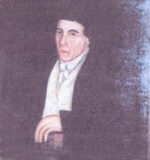

Top to bottom:
Sunrise on the Ohio River.
Portrait of Major William Chenoweth.
The original Chenoweth tombstones were in very poor condition. The family and church members erected the current stone marker in 1980 to ensure future family and church members know the Chenoweth contributions to both the Revolutionary War and their community of Deatsville, Ky.
Major William Chenoweth,
1760-1828
George Rogers Clark frontier campaign, "corn stock militia"
Anna (Faith) Wheeler's 3rd great grandfather
William Chenoweth was born in 1760 and was only fifteen years old when the Revolutionary War began in 1775. Raised on the Virginia frontier, Chenoweth came of age during a period when western settlements faced constant threats from British forces and their Native American allies.
He was recruited by George Rogers Clark during Clark’s efforts to gather experienced frontiersmen for an ambitious western campaign. Clark traveled through the frontier regions of Virginia and Pennsylvania seeking men willing to join an expedition into the Illinois Country. His objective was to strike British strongholds at Kaskaskia and Cahokia along the Mississippi River, capture Fort Sackville at present-day Vincennes, and conduct additional campaigns against Native American forces allied with the British.
By 1780, Chenoweth had earned a Virginia military land bounty warrant (#5080) issued by Governor Patrick Henry, granting him the right to claim 600 acres of land for his Revolutionary War service. He eventually settled in what became Nelson County, Kentucky.
In 1782, Chenoweth served a thirty-five-day enlistment in the Jefferson County Militia. Once again under the command of General George Rogers Clark, his unit was called into service to defend Kentucky settlements from Native American attacks. He later continued his militia service in the early Kentucky state militia, eventually achieving the rank of major.
Some early Kentucky militias were informally referred to as the “Cornstalk Militia,” a humorous nickname reflecting the frontier’s lack of resources. Many settlers lacked proper military equipment and training, and early militia musters could resemble community gatherings as much as formal military exercises. Despite their sometimes-improvised nature, these local militias provided essential defense for frontier communities and supplied manpower for later conflicts, including campaigns connected to the Northwest Indian War and the years leading up to the War of 1812.
In 1781, Chenoweth married Mary Van Meter Henton, the daughter of Jacob Van Meter (1723–1798) and Letitia Van Meter. Mary was the widow of David Henton, who drowned while traveling with the Van Meter family migration group down the Ohio River by flatboat. Chenoweth administered Henton’s estate before marrying Mary. This marriage united two prominent frontier families whose members participated in the Revolutionary War and early Kentucky settlement.
Beyond his military service, Chenoweth was a planter, miller, stone mason, and public servant. He represented his community in the Kentucky House of Representatives and became a respected figure in early Kentucky settlement. William and Mary donated a corner of their land for the establishment of New Salem Baptist Church in Deatsville, Kentucky, reflecting their role in the growth of their frontier community.
William Chenoweth’s life represents the experience of many Revolutionary-era frontiersmen: soldiers who helped secure the western frontier, settlers who transformed wilderness into communities, and civic leaders who shaped the early state of Kentucky.
Children include: Jacob Van Meter, 1784-1851; Abraham, 1785-1861; Miles Hart, 1791-1845; Letitia Van Meter Chenoweth Hawkins, 1796-1875; Ruth Chenoweth Forman, 1799-1868; James Hackley, 1801-1882.